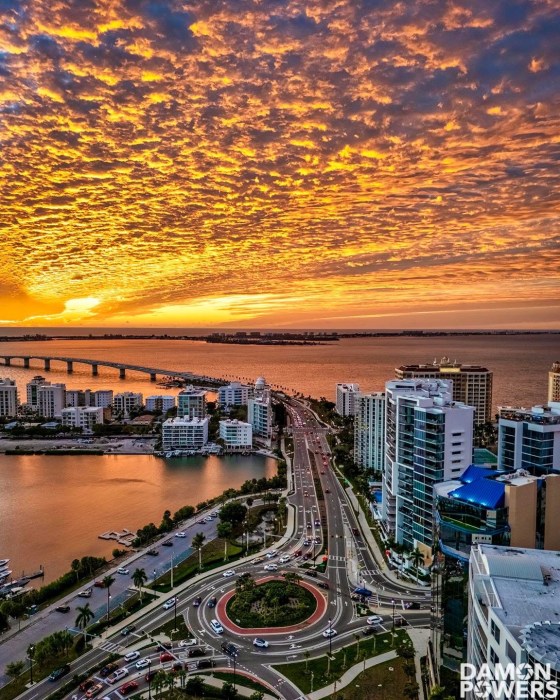
May 2026 | Market Intelligence Report by Sean Dreznin via numerous sources listed.
If you’ve been paying attention to headlines about Florida real estate lately, you’ve seen the full spectrum — from breathless warnings of a market crash to equally breathless proclamations that the Sun Belt is still the place to be. The truth, as it usually does, lives somewhere in the middle. And on Florida’s Gulf Coast — specifically across Sarasota, Manatee, and Pinellas counties — the multifamily market is telling a story that’s more nuanced, more interesting, and frankly more instructive than either extreme would suggest.
Call it the Great Recalibration. The multifamily sector here is digesting an extraordinary wave of new supply, repricing itself in real time, and setting the stage for what could be a compelling recovery cycle — if you know where to look.
A Supply Wave Unlike Anything in a Generation
Let’s start with the most defining force in this market right now: supply. The construction boom that began during the pandemic-era migration surge has produced an apartment pipeline that, by some measures, is the largest this region has seen in decades.
The North Port–Sarasota–Bradenton metro issued permits for 65 multifamily units per 10,000 residents between July 2024 and June 2025 — the highest permitting rate in the entire country during that period. The national average, for context, was just 12.8 units per 10,000 residents. Sarasota alone is set to add roughly 3,800 new apartment units in the near term, a figure CoStar describes as the largest supply wave in a decade for this market.
The consequence of that pipeline landing all at once is now plainly visible in the data. CoStar reported Sarasota’s multifamily vacancy rate climbed to 16.5% in mid-2025 — a 25-year high. Average asking rents on Zillow dropped to approximately $2,500 per month, down roughly $315 year-over-year. On Apartments.com, a typical 750-square-foot unit in the market was leasing for around $1,777, down 4.3% year-over-year.
These are real numbers, and investors and operators who pretend otherwise are doing themselves a disservice. Now is an important time to adjust and recalibrate to where the market is and prepare for where it could be headed.
Not All Vacancy Is Created Equal
Here’s where the narrative gets more interesting. That 16.5% headline vacancy figure deserves some context, because it is, in part, an artifact of how quickly new product delivered — not necessarily a signal of structural demand failure.
Kevin Robbins, president of Robbins Commercial Real Estate, put it well: “Two years ago we were at zero or near-zero percent vacancy. If that’s the comparison, then yes, vacancies are higher now. But that doesn’t mean the market is unhealthy. It’s like home sales: before, houses were selling instantly, and now you have to market a home for three to four months. That’s a more normal pace.”
He’s right. What the market is experiencing is a re-normalization, not a collapse. Healthy vacancy for a rental market generally runs in the 5-8% range, allowing for normal turnover without tipping into oversupply or runaway rent growth. The current elevated vacancy is the predictable result of absorbing a historic construction wave in a compressed timeframe.
Doug Ressler, manager of business intelligence at Yardi Matrix, offered a similar take: “We don’t see it as saturation.” His estimate is that the current wave of new units could take until late 2027 to be fully leased — and that once absorbed, rent growth will resume.
The Luxury Pivot — and Its Limits
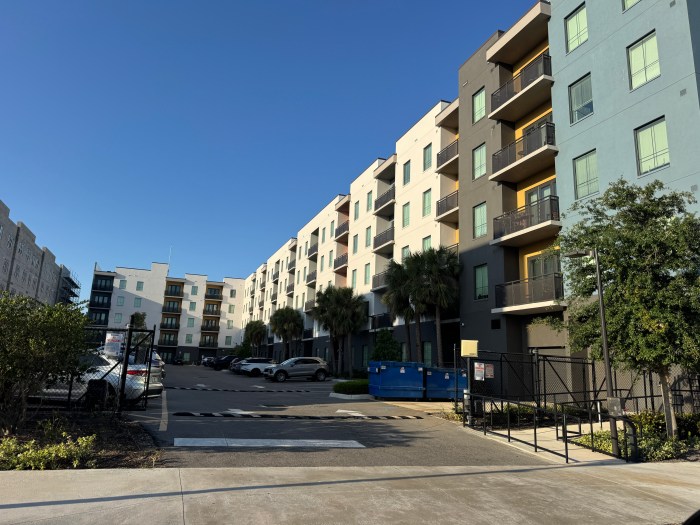
Walk around downtown Sarasota or St. Petersburg today and the character of the new construction is hard to miss. These aren’t your garden-variety garden apartments. Projects like Aster and Links represent a distinctly upmarket trend — what Robbins describes as “true luxury, like condos but in rental form.” Sarasota, he notes, is “upping its game to what you’d see in the Northeast.”
That premium positioning reflects developer logic: in a high-cost construction environment — where elevated insurance premiums, stubbornly high material costs, and expensive debt have pushed replacement costs for a mid-rise, surface-parked garden product to $350,000–$385,000 per unit — luxury rents are the only pencil that pencils. You cannot build affordable housing at those input costs without subsidy.
The tension this creates is real. The region’s strong population growth — Sarasota County has grown 14% since 2010, and Florida as a whole added 1.5% more residents in 2024 alone — is not exclusively being driven by high-net-worth retirees and remote workers from the Northeast. Healthcare workers, hospitality employees, teachers, and trade workers all need places to live. The University of Florida’s 2025 Rental Market Study found that nearly 905,000 low-income renter households across the state — roughly one in three — are cost-burdened, spending more than 30% of income on housing. The assisted housing stock covers only 314,000 of those units.
There is an affordability gap widening at the exact moment the luxury pipeline is delivering. Savvy investors who can find a way to serve the workforce housing tier — either through value-add strategies on aging stock or Live Local Act entitlements — are looking at a structurally undersupplied niche in a growing market.
Pinellas: A Market in Its Own Lane
While Sarasota and Manatee dominate the new construction conversation, Pinellas County — home to St. Petersburg and Clearwater — is navigating a somewhat different set of pressures.
The county’s more mature, denser urban fabric means there is less raw land for greenfield multifamily development. What’s happening instead is a rotation of ownership on existing assets, often paired with significant capital improvements and repositioning.
Recent transaction activity underscores this: an Austin-based firm paid $37 million for the 304-unit Gateway on 4th Apartments in St. Petersburg in July 2025, with plans to renovate and reposition the 1974-vintage property. A Clearwater high-rise sold for $22.5 million and returned to affordable housing use, backed by a public-private partnership with Pinellas County and approximately $25 million in planned renovations. The Pinellas Housing Authority acquired the Portland Apartments — a 12-story building at 300 8th Street North — for $8 million.
This pattern of institutional capital targeting value-add and workforce-repositioning plays in an infill urban market is a meaningful signal. It suggests investors see durable long-term demand in the St. Petersburg–Clearwater corridor, even if premium new construction is more limited by geography.
The Insurance Elephant in the Room
No honest conversation about Gulf Coast Florida real estate can avoid the subject of insurance. It is the single largest non-operating-cost variable affecting asset underwriting right now, and in many cases it is the factor separating a deal that makes sense from one that doesn’t.
In coastal and near-coastal markets, property insurance costs have risen 20–50% in recent years. For some waterfront assets, annual insurance expenses can exceed $1,800 per unit. This has direct consequences for NOI, debt coverage ratios, and ultimately cap rates. It has also contributed to a notable pattern: some smaller landlords, particularly those who own older coastal multifamily stock, are choosing to exit rather than absorb rising operating costs and capex demands from Florida’s condominium inspection laws.
That exit pressure is creating transaction opportunities for well-capitalized buyers who can absorb the insurance reality into their underwriting and still execute a value-add thesis. Properties east of I-75, where elevation is higher and insurance costs structurally lower, are generating particular investor interest for exactly this reason.
The Macroeconomic Backdrop: Rates, Migration, and the Path Ahead
Interest rates remain the central variable governing deal velocity. The average 30-year mortgage rate hovered around 6.6% through most of 2025, with Realtor.com forecasting modest easing to approximately 6.3% through 2026. That marginal improvement is meaningful for multifamily financing but is not the rate environment that defined the 2019–2021 deal boom.
The consequence of the rate environment is two-fold. First, the lock-in effect continues to suppress single-family home sales, keeping more potential homeowners in the rental pool and supporting apartment demand. Second, new construction starts have fallen sharply — Tampa saw fewer than 350 multifamily units break ground in Q4 2024, the lowest quarterly total in nine years, and the construction pipeline nationally is down more than 50% from its peak. That pipeline contraction is the setup for the next cycle’s rent growth.
Migration fundamentals remain intact. Florida added roughly 1.5% more residents in 2024, and Sarasota and Manatee counties continue to attract inbound relocators from the Northeast and Midwest at rates well above national norms. The unemployment rate in the greater Sarasota–Bradenton–North Port area was approximately 3.9% as of late 2024 — below the national rate and indicative of a healthy local economy.
Yardi Matrix’s Ressler summarized the forward view this way: by mid-2027, the current supply wave is expected to have been absorbed, and assuming migration continues at its current pace, rental rates should begin moving upward again.

What This Means for Investors and Developers
The market has moved from a phase where you could succeed with almost any strategy, to one where precision matters. Here’s what the current environment rewards:
Patience on new construction. The concessions environment is real. Developers delivering new luxury product today are offering 4–8 weeks of free rent on 12-month leases in some submarkets to hit occupancy targets. If you’re penciling a new development with 2022 rent assumptions, update your model.
Value-add on existing workforce stock. Older Class B and C properties — particularly those in infill Pinellas locations or in Manatee markets that didn’t benefit from the luxury delivery boom — offer yield in an environment where Class A product is competing itself down.
Geography still matters enormously. Markets east of I-75 in Manatee and Sarasota counties combine lower insurance costs, strong population growth, and relative scarcity of institutional-grade product. Lakewood Ranch specifically has proven to be one of the most consistently performing multifamily submarkets in the region.
The absorption clock is ticking toward opportunity. If the Yardi Matrix thesis is correct — absorption completing by mid-to-late 2027, followed by renewed rent growth — the window for acquiring assets at current prices, with stabilized vacancy embedded in the underwriting, is finite.
The Bottom Line
The Gulf Coast Florida multifamily market is not broken. It is not in freefall. It is in the unglamorous middle phase of a supply cycle — the part where patience is required, where underwriting discipline separates the opportunistic from the reckless, and where the foundations for the next growth run are quietly being laid.
The supply is real. The rent corrections are real. The insurance headwinds are real. But so is the population growth. So is the migration demand. So is the structural undersupply of workforce housing. And so is the fact that the construction pipeline is already shrinking, which means the market that looks challenging today is likely to look considerably different by 2027.
The investors who understand that distinction — and act accordingly — tend to be the ones writing the most interesting deal memos a few years from now.
This post reflects publicly available market data from CoStar, Yardi Matrix, Zillow, Apartments.com, the REALTOR® Association of Sarasota and Manatee, Florida Realtors, and reporting from the Business Observer. It is intended for informational purposes only and does not constitute investment advice.

If you would like to discuss the markets or commercial real estate concerns, I’m here to connect.
If you would like to connect about purchasing or considering selling, I’m a text, phone call or email away as well.
Dreznin Pappas Commercial Real Estate LLC
Sean Dreznin
941.961.8199


Leave a comment