By Jay Parsons via LinkedIN <— Click here to view complete articles and other research from Jay.
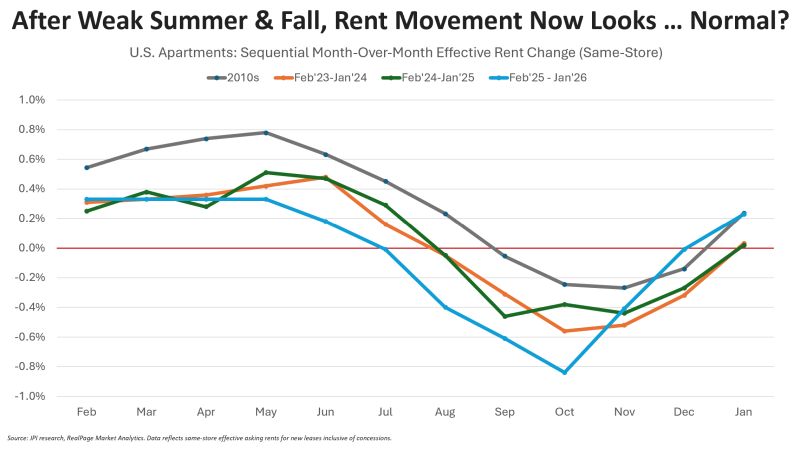
Apartment rents tanked in the summer and fall; but over the winter months, rent shifts suddenly look … normal. Month-over-month rent change for November-December-January all came in right around the pre-pandemic averages.
Look at the blue line in the chart below. It maps month-over-month rent change (inclusive of concessions) from February 2025 to January 2026. It shows how rent cuts were abnormally big from June to October last year … not only deeper than 2010s norms (in gray on the chart), but deeper than the cuts from 2023-24 (in green and orange) as well. But starting in November, the blue line jumps over the 2023-24 lines and tracks more closely with the 2010s averages.
This is an encouraging sign, but let’s get a few disclaimers out of the way:
1) “Normal seasonality” doesn’t mean “strong” — especially this time of year. These are still soft rent numbers (MoM -0.4%, 0.0%, +0.2% over last three months). But it does mean it’s better than the prior two years. We’re talking “green shoots” not “green fields” here.
2) Winter is the least important season for apartment leasing. It’s a seasonally slow period, and expiration management means fewer leases expire during the cold-weather months.
3) So while these winter numbers are encouraging, they really don’t translate to much yet. What really matters is the spring leasing season starting in March (or maybe even late February).
4) Year-over-year rent change (the more-watched number) is still weak. By all accounts, that number is still hovering somewhere around 0% depending on your data source.
But this chart hints at possible improvement over the summer months when 2025’s abnormally weak numbers drop out of the year-over-year calculation. You don’t have to see normal seasonal rent increases in summer 2026 for the YoY number to improve… it just has to be less-bad than 2025. And barring further weakening in the job market, that’s certainly possible given the big drop in new supply delivering this year.
5) What markets saw the most improved momentum over the last three months? It’s a mix of low-supply markets (San Francisco, Virginia Beach, Cleveland, Kansas City, etc.) and high-supply markets (Denver, Jacksonville, Orlando, Phoenix, Dallas, etc.). Of course, year-over-year rent change remains negative across the high-supply markets. But if the current pattern holds through spring, it could mean the rent bottom was fall 2025.
Again: It’s all about the spring leasing season! We’ll see what happens…
Predictions?
 The Commercial Real Estate Alpha Site
Leave a comment