Apartment Market: National Cap Rate Trends
The declining trend in apartment cap rates is a familiar, yet still unexpected story, given that the Fed has raised its overnight borrowing rate by 25 basis points in each of the last three quarters and in six of the last seven quarters (from 0.5% to 2.0%).
Not only did the average apartment cap rate decline in the quarter by 20 basis points to 5.5% (the lowest ever), it has also declined in four of the last five quarters. This phenomenon is defying the conventional wisdom that cap rates move with interest rates.

There are two likely reasons for this trend. First, the data is subject to selection bias: cap rates are calculated based on properties that traded in the quarter.
Very often, sales are heavily weighted by higher-end properties in high-priced markets. This may be the case, given that the mean transaction value per square foot increased to $169,000 in the quarter – the second highest ever and above the previous quarter’s average of $165,000.
Overall transaction volume fell to $17 million from below $21 million in the first quarter, and an average of $22 million per quarter in 2017. This means that larger properties traded in the quarter and these generally have lower cap rates than smaller properties. The other reason that cap rates fell in the fourth quarter is likely due to an investor preference for this asset class over other property types.
Although the average apartment vacancy rate increased to 4.8% from 4.3% a year ago, the effective rent growth was positive at 1.3% in the quarter and 4.1% for the year. Thus, despite the increase in construction, the apartment market remains healthy and in demand for investors.
The 12-month rolling cap rate also fell 20 basis points to 5.6% in the quarter- also the lowest ever. The red line in this chart clearly shows a declining trend in apartment cap rates over the last three quarters after it had stagnated at 6.0% for the previous six quarters.
Although most cap rates should start to increase in line with the jump in the ten-year treasury note, the apartment cap rates will likely stay disproportionately lower than other property types over the next few quarters, as this remains a preferred asset class.
Apartment Market: Cap Rate Trends by Region
Apartment cap rates are declining across most of the U.S. outside of the Midwest.
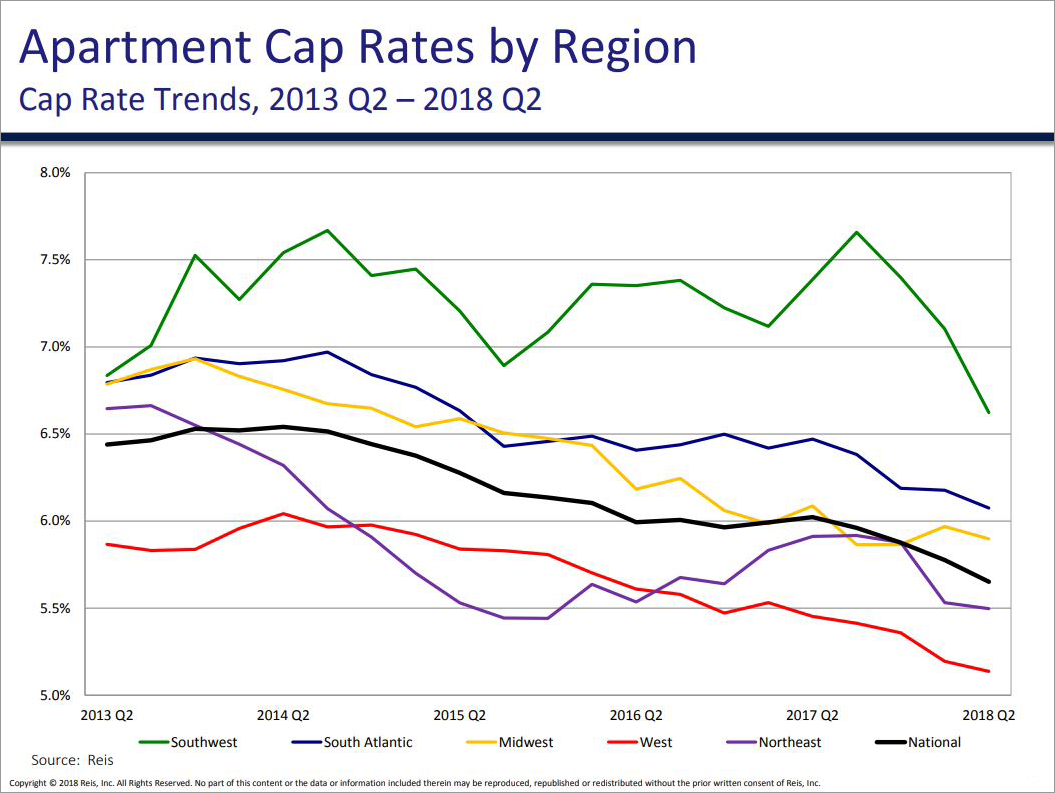
The Southwest region, which is dominated by Texas, has the highest cap rates; the hurricanes in 2017 pushed cap rates higher at the end of the year, but rates have corrected in the last two quarters. The Southwest region accounts for only 8% of the total U.S. sales volume.
 The Commercial Real Estate Alpha Site
Leave a comment